Udith Vaidyanathan
A friend of mine runs Medical Affairs at a mid-size oncology company. Last month, she told me three different vendors pitched her "AI agents" in the same week. When she asked each of them what, specifically, made their product an agent rather than a chatbot with a nice interface, she got three completely different answers. One of them, she's pretty sure, was just describing autocomplete.
This is the state of things. The terms "copilot" and "agent" have entered the pharma AI vocabulary at roughly the same speed, with roughly the same level of precision — which is to say, not much. They show up in vendor decks, conference panels, and internal strategy documents, often interchangeably, as if the distinction were a matter of branding rather than architecture.
It's not. The difference between a copilot and an agent is the difference between a tool that helps you do your job and a system that does parts of your job. And if you're operating in a regulated environment — which, hello, you are — that distinction has real consequences for governance, validation, and how much trouble you can get into.
The copilot: your very fast, very literal assistant
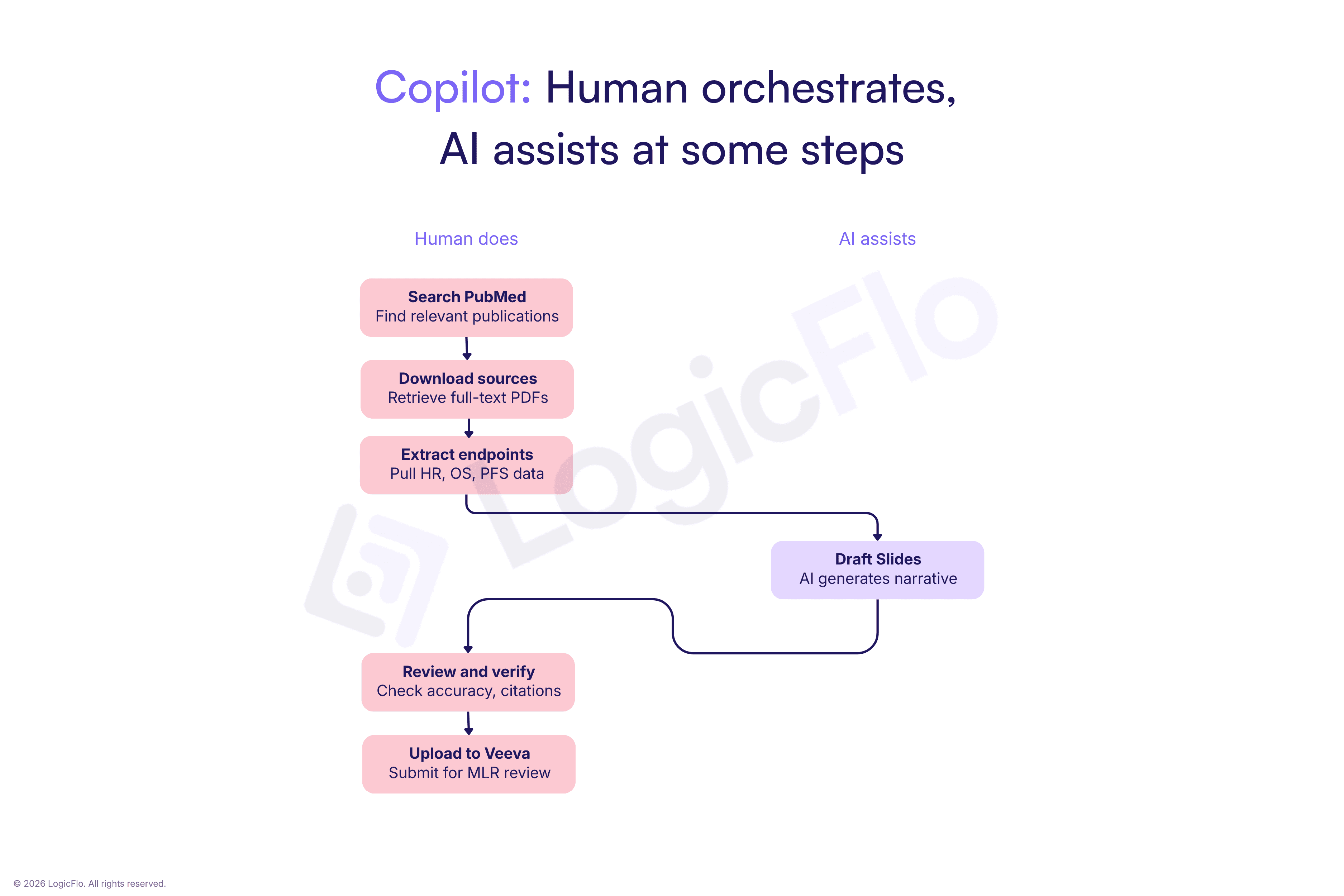
A copilot is what most people are actually using when they say they're "using AI." It sits inside a tool you already have — Word, PowerPoint, your email client, maybe your CRM — and it responds to what you ask it. You type a prompt, it generates a draft, a summary, a rewrite. Then it waits for you to ask it something else.
Think of it this way: a copilot is like a medical writing contractor who works incredibly fast but has no initiative. They'll turn your bullet points into a narrative. They'll clean up your safety language. They'll make your slides less ugly. But they won't go find the source publications, verify the hazard ratios, check the confidence intervals, or upload anything into Veeva. You're still the one running the workflow. The copilot just makes individual steps less painful.
This is genuinely useful. If you've ever stared at a blank slide at 9pm trying to summarize Phase III data for an advisory board, you know that "less painful" is not a small thing. Copilots reduce blank-page friction, speed up drafting, and help you get from messy thinking to presentable language faster.
But the workflow itself doesn't change. You're still the orchestrator. The copilot is a faster pair of hands, not a second brain.
The agent: something meaningfully different
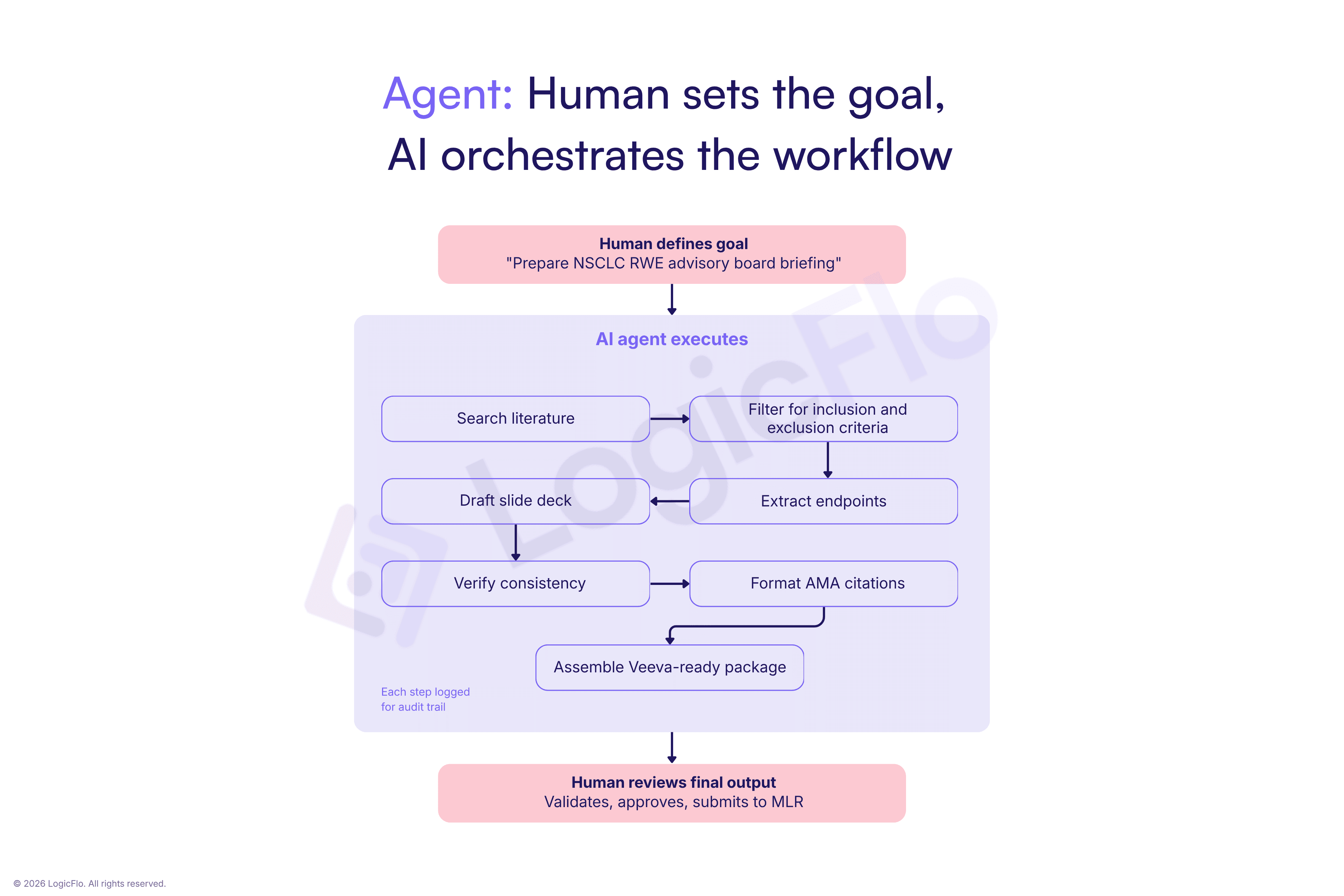
An agent doesn't wait for you to tell it what to do next. You give it a goal — "prepare a briefing document on emerging real-world evidence in non-small cell lung cancer" — and it figures out the steps. It searches the literature. It applies your inclusion criteria. It extracts the endpoints. It formats the citations. It drafts the slides. It assembles the package.
The underlying architecture is different in ways that matter. Agents use frameworks (like ReAct or tool-calling protocols) that let them reason about what to do next, select appropriate tools, execute steps in sequence, evaluate whether the intermediate output is any good, and iterate. A copilot predicts the next word. An agent plans the next action.
That's not a subtle distinction. It's the difference between a system that helps you draft a medical information response and a system that runs your literature surveillance pipeline. One makes a task faster. The other compresses an entire workflow.
Now, here's where I want to be honest with you, because this is also where the vendor pitches get ahead of reality.
What this actually looks like in regulated pharma (today)
Most of what's being sold to pharma companies as "agents" right now lives somewhere on a spectrum between genuine multi-step orchestration and a copilot with a for-loop bolted on. The technology for real agentic workflows exists — the research is solid, the frameworks are maturing — but deploying it in a GxP environment is a different proposition than deploying it in a tech startup.
Why? Because in pharma, the governance burden scales directly with autonomy. When a copilot helps you draft a slide, the compliance picture is relatively clean: you prompted it, you reviewed the output, you're accountable. Standard MLR review still applies. You log your prompts, you verify your citations, you move on.
When an agent executes a six-step literature synthesis pipeline, the questions multiply. Did it apply the inclusion criteria correctly at step two? Did it extract the right endpoints at step four? Can you trace every claim in the final document back to its source? Can someone else reproduce the output? Are there validation checkpoints between steps, or does the system just barrel through to a finished product and hand it to you with a confidence score and a prayer?
This isn't a reason to avoid agents. It's a reason to be precise about what you're buying and what governance infrastructure you need around it. The organizations that will deploy agentic AI well in pharma are the ones building step-level audit trails, source traceability, and human-in-the-loop checkpoints — not the ones buying a platform and hoping the vendor thought about compliance so they don't have to.
The uncomfortable truth
Here's the thing nobody in a vendor pitch will tell you: most Medical Affairs teams aren't bottlenecked by drafting speed. They're bottlenecked by review cycles, cross-functional alignment, and the seventeen-step approval process that turns a two-page document into a six-week odyssey. A copilot that helps you draft faster is nice, but it doesn't solve a workflow problem. And an agent that automates literature extraction is powerful, but it's solving a problem that may not be your most expensive one.
Before you evaluate any AI tool — copilot or agent — the useful question is: where is the actual friction in this workflow? If it's at the drafting stage, a copilot is probably sufficient and dramatically easier to govern. If it's in the multi-step orchestration of structured, repeatable processes (literature surveillance, congress coverage, evidence table construction), that's where agentic approaches start to earn their complexity budget.
Confusing the two leads to one of two outcomes, both bad: you buy a copilot expecting workflow transformation and get disappointed, or you buy an agent without the governance infrastructure to use it safely and get something worse than disappointed.
A practical heuristic
When someone pitches you an AI tool, ask this: "If I give this system a goal and walk away for an hour, will it have done multiple things, or will it be waiting for my next instruction?"
If it's waiting, it's a copilot. Useful, lower-risk, and probably where most teams should start.
If it's been busy, it's an agent. Potentially transformative, but you'd better have a clear answer for how you'll audit what it did while you were gone.
The distinction isn't about which one is better. It's about which one matches the problem you actually have — and the governance maturity you actually possess. In Medical Affairs, getting that match right is the difference between a tool that helps and a system that creates a new category of risk you didn't budget for.